Continuing our video tutorial series, here's Professor Paul DeNigris with three lessons about setting up the Redrock Micro DSLR rig.

Showing posts with label DSLR. Show all posts
Showing posts with label DSLR. Show all posts
Friday, August 2, 2013

Wednesday, February 29, 2012
Saturday, February 25, 2012
ProLost: 'Red Scarlet, Canon C300, and the Paradox of Choice'

All filmmakers are on a journey, and that journey is going to take you through many cameras. It’s dangerously easy to get swept up in advancing technologies, and all-too tempting to think that a new camera will slingshot your filmmaking forward.Read Stu's entire post for the run-down on the capabilities and pricing of the current crop of digital cameras, from the Red Epic M ($43,000) down to the Canon Rebel T3i ($659).
Thursday, December 1, 2011
Pixiq: 'Everything About Camera Lenses'

Wednesday, September 28, 2011
Philip Bloom: 'Canon DSLRs: some of the best picture profiles out there'

For all projects that I am producing, I always shoot the flattest image I can get. However, when shooting for others, if the turn around time does not allow for colour timing/correction, I will shoot less flat (typically neutral).
Read the rest here!
Now you ask, why is a flat profile important? Well, when you bake-in the color/contrast settings into an image (pre-set PP’s), you are unable to retrieve information that would be available if you had shot flat. Say your sky is blown out, but you wish you could see some of the clouds that were there on the day. With a baked-in image style, you are not able to recover it. With a flat image, you have a much better chance of recovering the clouds — OR if you under or over-expose something, you have a better chance to recover information that would otherwise be lost.
Wednesday, September 21, 2011
Vincent Laforet and Vimeo go 'Behind the Glass'

Thursday, August 11, 2011
CAPTAIN AMERICA Action Shots Captured with Canon 5D Mark II DSLRs

Canon U.S.A. has announced that the highly anticipated feature film, Captain America: The First Avenger, used Canon EOS 5D Mark II Digital SLR cameras to capture many of the movie’s action shots. Throughout the super hero action picture, the 5D Mark II was used to shoot motion sequences that were seamlessly integrated with the production’s 35mm film footage.Read the full article here.
Monday, August 8, 2011
The best ISO settings for your Canon DSLR
DP / filmmaker Andrew Schar recently posted this informative video comparing the noise inherent to various ISO settings on Canon DSLR's in movie mode. I for one will be sticking with multiples of ISO 160 from now on!
Tuesday, June 7, 2011
IFP/Phoenix Offers Hands-On DSLR Filmmaking Workshop June 25th

Time: 12:00pm-4:30pm
Where: IFP/PHX Classroom
1700 North 7th Avenue #250
Phoenix, AZ 85007
So... you're telling me that a little DSLR camera, one that normally takes photographs, can be used to shoot my next independent film? YES!
In this 4-hour hands-on workshop, we'll show you the key things you need to know to be able to shoot your next film on a DSLR camera!
We will have 3 cameras on-hand for you to get your hands-on. Canon 7D, Canon 60D, Canon T2i. If you have your own DSLR, bring it along and we'll show you the ropes!
Topics that will be covered:
- Overview of the body, operation, and menus
- Camera "rigs", rails, follow focus, matte box, monitors
- Getting proper exposure
- Selecting and configuring custom presets
- Controlling your depth of field
- Reducing rolling shutter effects
- Recording audio for your film
- Shooting some test footage!
- Post production workflow
- Color correction for optimal results
*Tickets: $30 IFP/PHX members (use code IFPPHX - subject to verification); $50 non-members
*Indicates pre-purchase price, add $5 for walk-ins (if available)
Purchase Tickets at:
http://www.brownpapertickets.com/event/179644
Tuesday, March 1, 2011
HDDSLR Workshops with Gale Tattersall
HDDSLR Workshops with Gale Tattersall on Vimeo.
More information about Gale Tattersall's workshops can be found here.Friday, February 25, 2011
Using Stills to Create Matte Painting Effects in Your Footage
Here's a cool technique, using the still-photography function of your HDSLR to gather more information and more latitude than the HD video function alone can capture. This "tutorial" is a little dry, but stick with it. This technique opens up LOTS of possibilities!
How to use stills to create simple matte painting effects for your DSLR footage from Robino Films on Vimeo.
Monday, February 21, 2011
Using Depth of Field for Storytelling
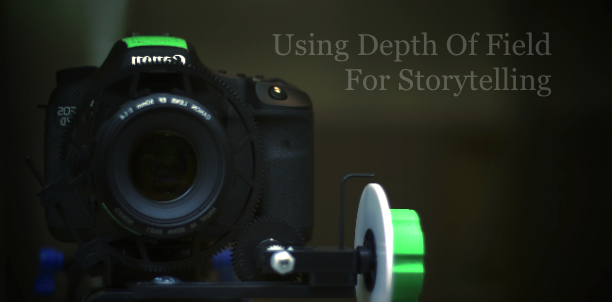
Here's a great article we picked up on the DSLR Video Shooter blog:
“To make your video look like film use shallow depth of field.” This is a line I hear a lot, especially from DSLR shooters and it could not be farther from the truth. Yes, films use shallow DOF but that does not make them films. Depth of field is a tool with which to sculpt your shots. So just because we can now shoot at F1.2 does not mean we should. I know most of us are recovering from Large Sensor Deficiency Syndrome but with a little education and therapy, we can move on.Read the rest here!
Thursday, February 10, 2011
Innovation: The Ice Book
Here's an amazing piece of film/theatre we first spotted over on Philip Bloom's excellent blog.
The Ice Book (HD) from Davy and Kristin McGuire on Vimeo.
"All we had was a 5D Mark ii, an old Macbook with After Effects, some builders lights and a green cloth that we improvised as a makeshift green-screen. Before we started we had no idea how to make pop-up books let alone how we could combine them with projections."
Monday, December 13, 2010
How to Increase Canon 5D/7D Dynamic Range
Photographer and DSLR videographer Luka has shared this video on his Vimeo page that has some great tips for getting the most of your Canon DSLR footage. He specifically talks about the 7D but these concepts all apply just as well to the 5D Mark II. A very funny and informative tutorial!
How to increase the Canon 7D dynamic range (Tutorial) from Luka on Vimeo.
Thursday, October 14, 2010
DP Shane Hurlburt Explains His HDSLR Shooting Protocol
For all of you venturing into making films using the Canon 5D Mark II or 7D or similar HD-enabled DSLR cameras, this invaluable video comes courtesy of Director of Photography Shane Hurlburt (DP of Terminator Salvation among many other films).
Thursday, July 22, 2010
New Short “Extraordinary Colleagues” Premieres Friday at Phoenix Art Museum

The film will screen twice, once during the 6pm show and again during the 8pm show. The “Beat the Clock” Awards will follow at 10pm. More details can be found on IFP/Phoenix’s website. Tickets for the screenings are $15 each.
“Extraordinary Colleagues” was a co-production between the UATDV crew and Locked Horns Productions. Students Nick Wassenberg, Justin Gagen, and Mitch Faherty handled visual effects with some assistance from alumni Kalki Khaira and Ryan Whitten. Alum Ryan Luibrand handled editing duties. Students Kenny Rayl, Shawn Geary, Erica Faccone, and Kari McBride handled physical production, lead by DP Justin Gagen and directed by Professor DeNigris.
"Extraordinary Colleagues" mark's UATDV's first production using our brand new Canon 5D Mark II DSLR. Visual effects were executed in Adobe After Effects, with the comic book panels processed in Photoshop. Editing was completed in Avid Media Composer, with sound mixing and sweetening done in ProTools.
Monday, August 17, 2009
Red One, Canon 5D Mk II, and Panasonic Lumix GH1 Footage Comparison
Here's an amazing bit of footage posted by premiere Hollywood equipment rental house Birns and Sawyer on their Vimeo channel.
What's so amazing about it? It compares side-by-side-by side the output of three hype-worthy cameras - the 4k-capable digital cinema RED ONE camera (roughly $20k) and two DSLRs equipped with "movie" modes, the $3500 Canon 5D Mark II and the $2200 Panasonic Lumix GH1. This is the first time I've seen footage from the Panasonic, and the first time I have seen anyone cut together material from a RED with footage from a DSLR. What it shows is that the technology has definitely shifted and this new generation of DSLRs are game-changers in terms of comparing price to image quality.
Red One, Canon 5D Mk II, and Panasonic Lumix GH1 Footage Comparison from Birns and Sawyer on Vimeo.
What's so amazing about it? It compares side-by-side-by side the output of three hype-worthy cameras - the 4k-capable digital cinema RED ONE camera (roughly $20k) and two DSLRs equipped with "movie" modes, the $3500 Canon 5D Mark II and the $2200 Panasonic Lumix GH1. This is the first time I've seen footage from the Panasonic, and the first time I have seen anyone cut together material from a RED with footage from a DSLR. What it shows is that the technology has definitely shifted and this new generation of DSLRs are game-changers in terms of comparing price to image quality.
Subscribe to:
Posts (Atom)