Showing posts with label Box Office. Show all posts

Tuesday, November 13, 2012

You Don't Want Original Content - You Just Think You Do

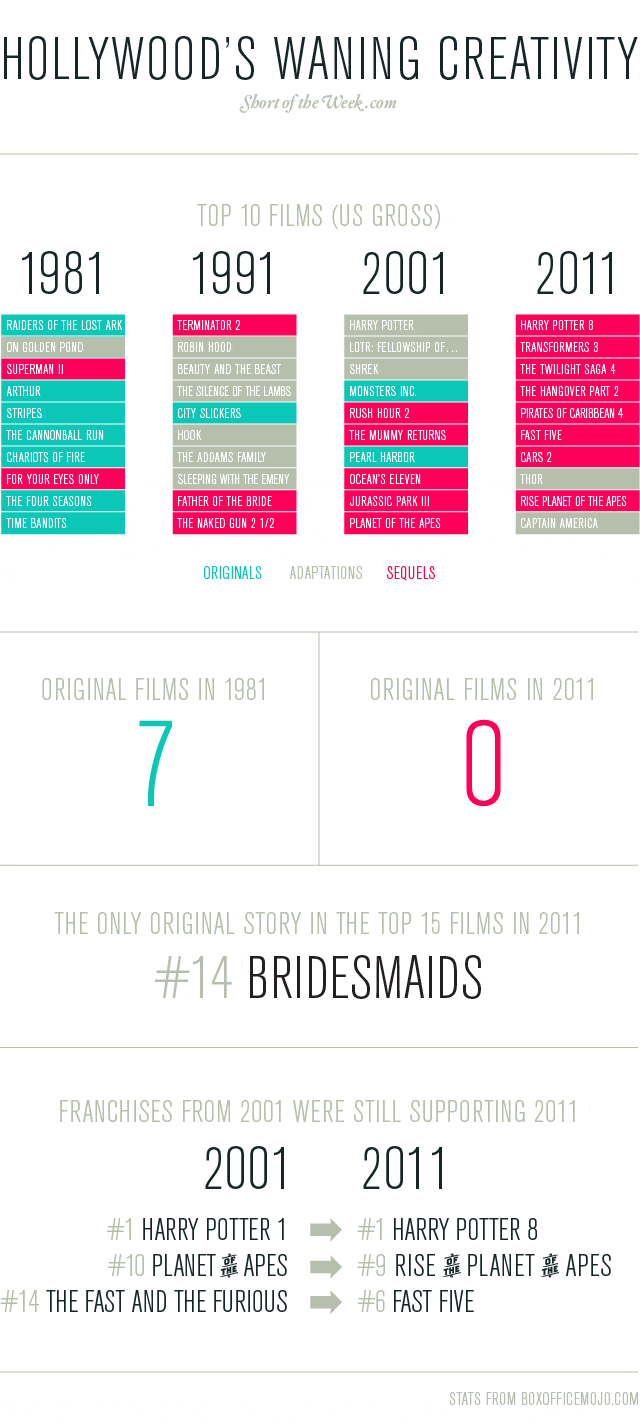
I hear it all the time. Hell, I say it all the time: "Why can't Hollywood make anything original any more?" We're inundated with a steady stream of sequels, remakes, reboots, reimaginings, and adaptations of material from other media (comics, novels, magazine articles, 80's TV shows). In fact a website titled "Short of the Week" famously looked at Hollywood's trend towards regurgitating the familiar, and spawned this infographic which went viral:


The infographic and its accompanying article were meant as a rallying cry to filmmakers and audiences alike, to stop regurgitating the same-old, same-old and to stop lapping it up like mother's milk. Filmmakers and film lovers took up the banner and cried out "Where are the new voices? The new visions? Give us original content! We demand it!"

Only thing is, you didn't mean it. Oh, your intentions were good. In your heart you really want those original visions. You want to be re-inspired by original movies the way you were when you were a kid. You want that thrill of discovery.

Only, you don't. Not really. There's so much content out there competing for your attention that to invest any sort of time, money, or energy into watching something requires you to know something about it beforehand. Maybe you read the graphic novel. Or played the videogame. Or at the very least you know who's in it. It needs to have a "brand." It needs to be familiar.

Let's take a look at two films that we've posted on our YouTube channel, "Fallout" and "Red Sand."


On the first glance they are fairly similar - both are sci-fi action movies, made with roughly the same production value, same level of acting, same level of writing, and with essentially the same runtime. However one has 4,500 views accrued in just over a year and the other has 133,000 views in just over a month.


So what's going on here? The power of the known property, that's what. "Red Sand" is based on the immensely popular Mass Effect videogame franchise. "Fallout," while sharing a title with another videogame property, is an original vision not otherwise tied to any known property. This alone accounts for the vast difference in the view counts of these two films. In fact a closer look at the stats for "Fallout" serves to prove my point further. There are several spikes in the views graph for "Fallout," the most noticeable of which falls on May 24, 2012 - the day after the release of our first trailer for "Red Sand," which has an advertisement for "Fallout" tagged on the end.


That tag on the end of the "Red Sand" trailer provided "Fallout" with its largest single-day viewing spike, though the comparison is still paltry. On May 24, the "Red Sand" trailer brought in over 13,000 views, and passed a mere 500 of those viewers over to "Fallout"(roughly 3.8%).


By comparison, "Fallout"'s own trailer has roughly 3,500 views and has, according to YouTube's stats, prompted just 37 of those viewers to watch the actual "Fallout" film (just over 1%).


Even this graph serves to prove my greater point - that the average viewer will only watch something if it's somehow been granted the appearance of a "known property." In this case, that big spike on April 5, 2011 is just days after "Fallout" won Best Arizona Short at the 2011 Phoenix Film Festival - an assertion of quality by a known entity which says to the viewer "this is worth your time."

So what's the solution for a filmmaker trying to get more eyeballs on his or her films? For a long time that solution seemed to be "name actors." Get a recognizable name and face in your film, and you've got a hit on your hands. Well, yes and no. Casting Mark Meer in "Red Sand" certainly ensured a fair amount of viewership (he is, after all, the voice of Commander Shepard in the Mass Effect games), though one would hardly call him a "household name." Yet in this case he seems to have much more marquee value than "bigger" names like Bill Engvall and Danny Trejo, the stars of our film "Cowboy Dreams" from 2008.


"Cowboy Dreams" was, like "Fallout," an Official Selection of the Phoenix Film Festival. However its total view count is right around 10,000 lifetime views.


Just by math alone, one could make the argument that name actors can roughly double your audience (10,000 for "Cowboy Dreams" compared to around 5,000 for "Fallout"), but a known property like Mass Effect can multiply your audience by a factor of 20 or more.

And before you dismiss this article as simply focusing on YouTube stats, realize that I am using these stats which I have at my fingertips to illuminate a broader point. One need look no further than this summer's box office to see the evidence of my thesis. Compare the opening weekends of the Alien prequel Prometheus ($51 million) and the original story Looper ($20 million). They're both high-concept sci-fi with all-star casts, and yet their box office takes are inversely proportional to their quality.

In conclusion, before you decry "Hollywood's lack of originality" you really should look at yourself - and the rest of the audience - as the ones lacking originality! It's you, the viewer, who doesn't embrace original visions, new voices, unique stories. It's you, the viewer, who is ensuring a continued diet of the same-old, same-old! So if you're truly tired of the regurgitated pablum Hollywood is feeding you - stop consuming it. Watch something new. Find those hidden gems on Netflix, Hulu, YouTube, Vimeo, etc. Go to a film festival. Check out the arthouse instead of the multiplex this weekend. But for the love of cinema, become part of the solution instead of just complaining about the problem!

Thursday, March 25, 2010

When Science Trumps Art

What to Blame When Bad Blockbusters Dominate the Box Office
By Nick Wassenberg

Despite prominent ridicule of Michael Bay's predilection for prioritizing gratuitous explosions over plot, 2009's Transformers sequel Revenge of the Fallen held top spots the box office charts for nearly two months before other high-profile films (Harry Potter 6, followed by District 9) stole the limelight -- no small feat considering the across-the-board panning it received from both esteemed reviewers and die-hard Transformers fans alike. Some argue that on-screen combustion and extensive action scenes cater to our generation of movie-goers which, when combined with the American public's fondness for escape via entertainment, contributed to the film's profits.

Professor James Cutting of Cornell University believes blockbuster success is due, in part, to manipulation of the audience's attention span.

Utilizing a process called the 'Fourier transform', people like James Cutting are able to apply a mathematical pattern of waves (representing the lengths of shots in a movie) known as 1/f fluctuation, to the behavior of a consumer's attention span. When overlaid, the two plots illustrate a significant effect made by the timing of cuts in accordance the audience's fluttering attention span.

Gizmodo.com: "...the more recent the blockbuster,
the more closely the length of its shots followed that
same fluctuation."

In the diagram above, Cutting compares the editorial timing of three movies from vastly separate eras. 2005's King Kong, though delivering less than was hyped, largely adheres to the 1/f pattern, whereas 1945's Detour, held in high regard, shares little resemblance. Yet despite its shortcomings, King Kong profited as admirably as Detour. The remarkable thing about this pairing is that King Kong tips the scales at over three hours long -- quite the oddity in a society driven by instant gratification and multitasking -- but succeeded in captivating its audience by following the 1/f formula. To contrast, the audiences flocking to Detour hadn't suffered from the same attention deficiency, allowing the film to flourish on its own merits.

Quotes PopSci.com:
“
Cutting doesn’t believe that this increasing conformity to the 1/f fluctuation resulted from a conscious decision on the part of the directors. Rather, he theorizes that films which fall into people’s viewing sweet spot better hold their attention, and thus seem more gripping, and make more money. Then the other directors naturally copy the pace of the more exciting, more profitable movies, and the 1/f fluctuation trend spreads.”

Not even industry-revolutionizing productions are exempt from using the Fourier transform method to engage their audiences. James Cameron's Avatar, weak in plot but employing myriad visual tricks and treats, is now the highest-grossing film of all time, not accounting for inflation. George Lucas' Revenge of the Sith, though victim of Lucas' diminishing popularity and riddled with continuity errors, also placed highly at the box office. While these two examples are deserving of their box office recognition (the former ushering in a new age of film-making and the latter delivering the final chapter of a hugely successful and cultural franchise), the relative success of the Transformers sequel could have the 1/f formula to thank for its domestic accomplishment, as might an alarming number of big-budget films from the past decade.

So while film students everywhere strive to instill innovative and artistic value into their productions, they'd do well to introduce another factor into their work: the Fourier method of ensnaring the masses.

James Cutting's full text can be found here.