Continuing from last week's "What's Expected of a Student Director," let's turn our attention to the person who makes the director's job possible - the producer. Producing can be a thankless job, one that many people - even people in the industry, sometimes - don't quite understand.
So what, exactly, is the job all about?
1. Breaking It Down. Producers thrive on "breakdowns." The Script Breakdown is a master list of every scene in the script and every character, prop, set, vehicle, etc. that will be required to film those scenes. The Casting Breakdown is the list of the characters in the film and the brief descriptions of the types of actors you want to read for those roles. The "Day out of Days" is another type of breakdown, used for scheduling actors ("Actor X is on set for 3 days out of a total of 10 days of filming," for example.)
2. Doing Paperwork. The paperwork doesn't end with the breakdowns. If you're using Screen Actors Guild actors, you need to file paperwork with the Guild 6 weeks before you start production. Once SAG approves your production, you sign more paperwork and become "SAG signatory," meaning you've now entered into a contract with the Guild. And that spawns more paperwork - actor contracts, time sheets, final production reports.
3. Wrangling Locations. If you want to shoot off-campus, you need to help your director find the locations that will work for the film. Then it's your job to get them to agree to let you film there. If it's a public location, you'll have to work with the local film office to get a permit (more paperwork). And a public or commercial location will most likely expect the production to have insurance - which UAT can provide after you do (you guessed it) more paperwork.
4. Scheduling. Your actors - SAG or otherwise - probably have day jobs. Your crew members have other classes, homework, part time jobs, social lives. Your locations have restrictions on when you can film there. Equipment gets reserved for other productions. Juggling all these factors to find the best times to get everyone and everything on set at the right times can be a full-time job unto itself.
5. Issuing Call Sheets. 12 to 24 hours before filming begins, it's your job to send out a call sheet to all cast and crew that includes the location address, call times for everyone to arrive on set, contact info for you and other key personnel, even the address of the nearest hospital in case someone is hurt on set. And as each shoot day wraps up, it's your job to issue the next day's call sheet.
6. Sticking to "12 On, 12 Off." Shoot days can be LONG. On student and indie projects they can get out of hand and go 16 hours or more. It's your job as producer to stick to a policy of no more than 12 hours of work on any one day, and no less than 12 hours off between wrap time on one day and call time on the next. Sometimes your director will work against you on this, going longer than planned. It's your job to encourage the director to wrap, or it's on you to revise your call time for the next day lest you incur the ire of your crew.
6. Feeding the Team. Like an army, a film crew moves on its stomach. A well-stocked craft services table, a constant flow of water, sports drinks, and coffee, bagels in the morning, and a hearty lunch halfway through the day will keep things running smoothly. And if you're working with SAG, remember to feed your actors at the 6 hour mark or risk violating your contract!
7. Preparing "Sides." Every day on set you need to provide the day's script pages - a.k.a. "sides" - to all department heads. These sides need to be half the normal size of script pages (i.e., two pages side by side on an 8 1/2 by 11 sheet of paper) and must only include the materials being shot today (meaning anything else gets blacked out with Sharpie). This is a daily task that on a bigger production would fall to a Production Coordinator or an Office PA, but since this is a student film - you're it.
8. Missing All the Action. You're going to be so busy making sure the next shoot day will go off without a hitch, that you're probably not going to be on set much, if at all. If you thrive on the nuts and bolts of filmmaking, then the producer gig isn't for you.
9. Getting Very Little Credit. Once the film is done, everyone is going to talk to the director, congratulate the director, praise the director, and credit the director for everything that went right in the film. No one in the general audience even comprehends everything you did to make the film possible, so try not to take it personally if they overlook you.
10. Realizing That You Are Now a Professional. In spite of all that, try and remember that there's a reason why it's the producer who gets the "Best Picture" Oscar at the Academy Awards - because without the producer, there is no movie. And now that you've been through this experience, you're ready for just about anything the industry is going to throw at you!

Monday, April 1, 2013

Thursday, March 28, 2013
Digital Video Deck Configuration Tutorial
If you've ever had trouble capturing your tapes into Avid Media Composer, this tutorial from Professor Paul DeNigris is for you!
Tuesday, March 26, 2013
What's Expected of a Student Director
So you want to direct, huh? You want to direct a big project. A BIG visual effects-driven project like a "Fallout" or a "Red Sand." Leading a team of students over multiple semesters to make something AWESOME.
Cool. Only you're not ready. Oh, you think you are, I know. But you're not the first student to think that, and you won't be the last. But no matter how ready you think you are, you're not. Most people aren't ready for the responsibility of directing a project like this until they've done it once before. Kind of a Catch-22.
But don't worry. I've compiled this handy list to help you through the process, a list of what your classmates and I will expect from you when you undertake the insane task of directing one of these behemoth productions.
1. You will work harder than EVERYONE on your team. This is your number one guiding principle. If anyone on your team - including me - is working harder on your film than you are, you're doing it wrong. Period.
2. Preproduction begins and ends with YOU. You need to oversee everything. Your team is going to need guidance on every decision - casting, costumes, props, sets, locations, concept art. Everything. If you're the director then the film is your vision, not someone else's. No decision should be made without your thumbs-up.
3. Know your script. Whether you wrote the script or not, you need to know every scene, every line of dialogue, every character, and how they all fit into the whole of the film. Read that document and commit it to memory.
4. Get on the same page with your Director of Photography as soon as possible. You and your DP need to be a team. Spend time talking about the script, particularly the emotional beats and how to visualize them. Write a shot list. Storyboard if you can. Draw blocking diagrams. But whatever you do, plan MEANINGFUL coverage that conveys your vision of the story. Make sure your DP buys into your vision so that there are no arguments on set. Ever. And once you and your DP are on the same page, you can focus on your actors when on set, rather than fussing about lenses and f-stops and debating the framing of the shot.
5. Trust and respect your team. Assume they are all going to get their work done to your satisfaction. Give them approval when possible, guidance when needed, and supervision when requested. But never micromanage. If your team feels like you're a tyrant who is going to undermine their every decision, they will no longer buy into your vision and will lose their motivation and passion for the project.
6. Set the tone on your set. Be the first person on set in the morning and the last to leave at night. Make sure your cast and crew have eaten before you grab your lunch. Say "please" and "thank you." Get your own coffee. Sit if you must while the take is rolling, but in between takes when your team is on their feet moving equipment, show some solidarity by being on your feet too. No one is expecting you to grip, but an offer to help once in a while wouldn't hurt. These little gestures will mean a lot to your crew in the long run.
7. Make your day. Your producers have been struggling to schedule your actors around their other gigs and their day jobs. Your team is forgoing doing their homework for their other classes. Your professor is giving up time with his family to make sure your film gets shot. It's on you to respect that by making sure that you make your day, every day. That means getting the shots you need to tell your story. Remember that "meaningful coverage" back in #4? Shoot it, while simplifying and streamlining wherever possible, but without sacrificing your story. Combining two shots into a single moving setup that better conveys the moment? Genius. Losing vital close ups because you shot 10 takes of a master shot? Unforgivable. Finishing on time but not getting the material the film needs to be successful ultimately undermines the whole project and disrespects the efforts of all involved.
8. Watch dailies. Review the previous day's footage before your next shooting day. Assess what worked and what didn't. Compare notes with your DP. Don't HOPE you got it, KNOW you got it.
9. Let your editor find the story. Your intentions were one thing. What you actually got on film is sometimes another thing entirely. If you've chosen your editor well, now trust that person to save you from yourself by finding the best version of the story that is possible with the footage you shot. No matter how insistent you are about your vision, sometimes it's just not there in the footage. Actors don't deliver the goods. The focus puller missed their mark. Dialogue is superfluous. Your direction was wrong. It happens. Let that stuff go and let your editor work.
10. Do some of the heavy lifting during post. Roto sucks. Greenscreens sometimes don't key. Camera tracking fails. Help out. Pick up some tough shots to work on. Be there with your post team while they're struggling. Let them know you haven't thrown them to the wolves. Stand with them, and they'll stand by you and your film.
Remember these ten rules and you'll have a better chance of a smooth and successful project. Disregard these rules at your - and your project's - peril.
Still want to direct?
Cool. Only you're not ready. Oh, you think you are, I know. But you're not the first student to think that, and you won't be the last. But no matter how ready you think you are, you're not. Most people aren't ready for the responsibility of directing a project like this until they've done it once before. Kind of a Catch-22.
But don't worry. I've compiled this handy list to help you through the process, a list of what your classmates and I will expect from you when you undertake the insane task of directing one of these behemoth productions.
1. You will work harder than EVERYONE on your team. This is your number one guiding principle. If anyone on your team - including me - is working harder on your film than you are, you're doing it wrong. Period.
2. Preproduction begins and ends with YOU. You need to oversee everything. Your team is going to need guidance on every decision - casting, costumes, props, sets, locations, concept art. Everything. If you're the director then the film is your vision, not someone else's. No decision should be made without your thumbs-up.
3. Know your script. Whether you wrote the script or not, you need to know every scene, every line of dialogue, every character, and how they all fit into the whole of the film. Read that document and commit it to memory.
4. Get on the same page with your Director of Photography as soon as possible. You and your DP need to be a team. Spend time talking about the script, particularly the emotional beats and how to visualize them. Write a shot list. Storyboard if you can. Draw blocking diagrams. But whatever you do, plan MEANINGFUL coverage that conveys your vision of the story. Make sure your DP buys into your vision so that there are no arguments on set. Ever. And once you and your DP are on the same page, you can focus on your actors when on set, rather than fussing about lenses and f-stops and debating the framing of the shot.
5. Trust and respect your team. Assume they are all going to get their work done to your satisfaction. Give them approval when possible, guidance when needed, and supervision when requested. But never micromanage. If your team feels like you're a tyrant who is going to undermine their every decision, they will no longer buy into your vision and will lose their motivation and passion for the project.
6. Set the tone on your set. Be the first person on set in the morning and the last to leave at night. Make sure your cast and crew have eaten before you grab your lunch. Say "please" and "thank you." Get your own coffee. Sit if you must while the take is rolling, but in between takes when your team is on their feet moving equipment, show some solidarity by being on your feet too. No one is expecting you to grip, but an offer to help once in a while wouldn't hurt. These little gestures will mean a lot to your crew in the long run.
7. Make your day. Your producers have been struggling to schedule your actors around their other gigs and their day jobs. Your team is forgoing doing their homework for their other classes. Your professor is giving up time with his family to make sure your film gets shot. It's on you to respect that by making sure that you make your day, every day. That means getting the shots you need to tell your story. Remember that "meaningful coverage" back in #4? Shoot it, while simplifying and streamlining wherever possible, but without sacrificing your story. Combining two shots into a single moving setup that better conveys the moment? Genius. Losing vital close ups because you shot 10 takes of a master shot? Unforgivable. Finishing on time but not getting the material the film needs to be successful ultimately undermines the whole project and disrespects the efforts of all involved.
8. Watch dailies. Review the previous day's footage before your next shooting day. Assess what worked and what didn't. Compare notes with your DP. Don't HOPE you got it, KNOW you got it.
9. Let your editor find the story. Your intentions were one thing. What you actually got on film is sometimes another thing entirely. If you've chosen your editor well, now trust that person to save you from yourself by finding the best version of the story that is possible with the footage you shot. No matter how insistent you are about your vision, sometimes it's just not there in the footage. Actors don't deliver the goods. The focus puller missed their mark. Dialogue is superfluous. Your direction was wrong. It happens. Let that stuff go and let your editor work.
10. Do some of the heavy lifting during post. Roto sucks. Greenscreens sometimes don't key. Camera tracking fails. Help out. Pick up some tough shots to work on. Be there with your post team while they're struggling. Let them know you haven't thrown them to the wolves. Stand with them, and they'll stand by you and your film.
Remember these ten rules and you'll have a better chance of a smooth and successful project. Disregard these rules at your - and your project's - peril.
Still want to direct?
Tuesday, November 13, 2012
You Don't Want Original Content - You Just Think You Do
I hear it all the time. Hell, I say it all the time: "Why can't Hollywood make anything original any more?" We're inundated with a steady stream of sequels, remakes, reboots, reimaginings, and adaptations of material from other media (comics, novels, magazine articles, 80's TV shows). In fact a website titled "Short of the Week" famously looked at Hollywood's trend towards regurgitating the familiar, and spawned this infographic which went viral:

On the first glance they are fairly similar - both are sci-fi action movies, made with roughly the same production value, same level of acting, same level of writing, and with essentially the same runtime. However one has 4,500 views accrued in just over a year and the other has 133,000 views in just over a month.

 So what's going on here? The power of the known property, that's what. "Red Sand" is based on the immensely popular Mass Effect videogame franchise. "Fallout," while sharing a title with another videogame property, is an original vision not otherwise tied to any known property. This alone accounts for the vast difference in the view counts of these two films. In fact a closer look at the stats for "Fallout" serves to prove my point further. There are several spikes in the views graph for "Fallout," the most noticeable of which falls on May 24, 2012 - the day after the release of our first trailer for "Red Sand," which has an advertisement for "Fallout" tagged on the end.
That tag on the end of the "Red Sand" trailer provided "Fallout" with its largest single-day viewing spike, though the comparison is still paltry. On May 24, the "Red Sand" trailer brought in over 13,000 views, and passed a mere 500 of those viewers over to "Fallout"(roughly 3.8%).

By comparison, "Fallout"'s own trailer has roughly 3,500 views and has, according to YouTube's stats, prompted just 37 of those viewers to watch the actual "Fallout" film (just over 1%).

Even this graph serves to prove my greater point - that the average viewer will only watch something if it's somehow been granted the appearance of a "known property." In this case, that big spike on April 5, 2011 is just days after "Fallout" won Best Arizona Short at the 2011 Phoenix Film Festival - an assertion of quality by a known entity which says to the viewer "this is worth your time."
So what's the solution for a filmmaker trying to get more eyeballs on his or her films? For a long time that solution seemed to be "name actors." Get a recognizable name and face in your film, and you've got a hit on your hands. Well, yes and no. Casting Mark Meer in "Red Sand" certainly ensured a fair amount of viewership (he is, after all, the voice of Commander Shepard in the Mass Effect games), though one would hardly call him a "household name." Yet in this case he seems to have much more marquee value than "bigger" names like Bill Engvall and Danny Trejo, the stars of our film "Cowboy Dreams" from 2008.
"Cowboy Dreams" was, like "Fallout," an Official Selection of the Phoenix Film Festival. However its total view count is right around 10,000 lifetime views.

Just by math alone, one could make the argument that name actors can roughly double your audience (10,000 for "Cowboy Dreams" compared to around 5,000 for "Fallout"), but a known property like Mass Effect can multiply your audience by a factor of 20 or more.
And before you dismiss this article as simply focusing on YouTube stats, realize that I am using these stats which I have at my fingertips to illuminate a broader point. One need look no further than this summer's box office to see the evidence of my thesis. Compare the opening weekends of the Alien prequel Prometheus ($51 million) and the original story Looper ($20 million). They're both high-concept sci-fi with all-star casts, and yet their box office takes are inversely proportional to their quality.
In conclusion, before you decry "Hollywood's lack of originality" you really should look at yourself - and the rest of the audience - as the ones lacking originality! It's you, the viewer, who doesn't embrace original visions, new voices, unique stories. It's you, the viewer, who is ensuring a continued diet of the same-old, same-old! So if you're truly tired of the regurgitated pablum Hollywood is feeding you - stop consuming it. Watch something new. Find those hidden gems on Netflix, Hulu, YouTube, Vimeo, etc. Go to a film festival. Check out the arthouse instead of the multiplex this weekend. But for the love of cinema, become part of the solution instead of just complaining about the problem!
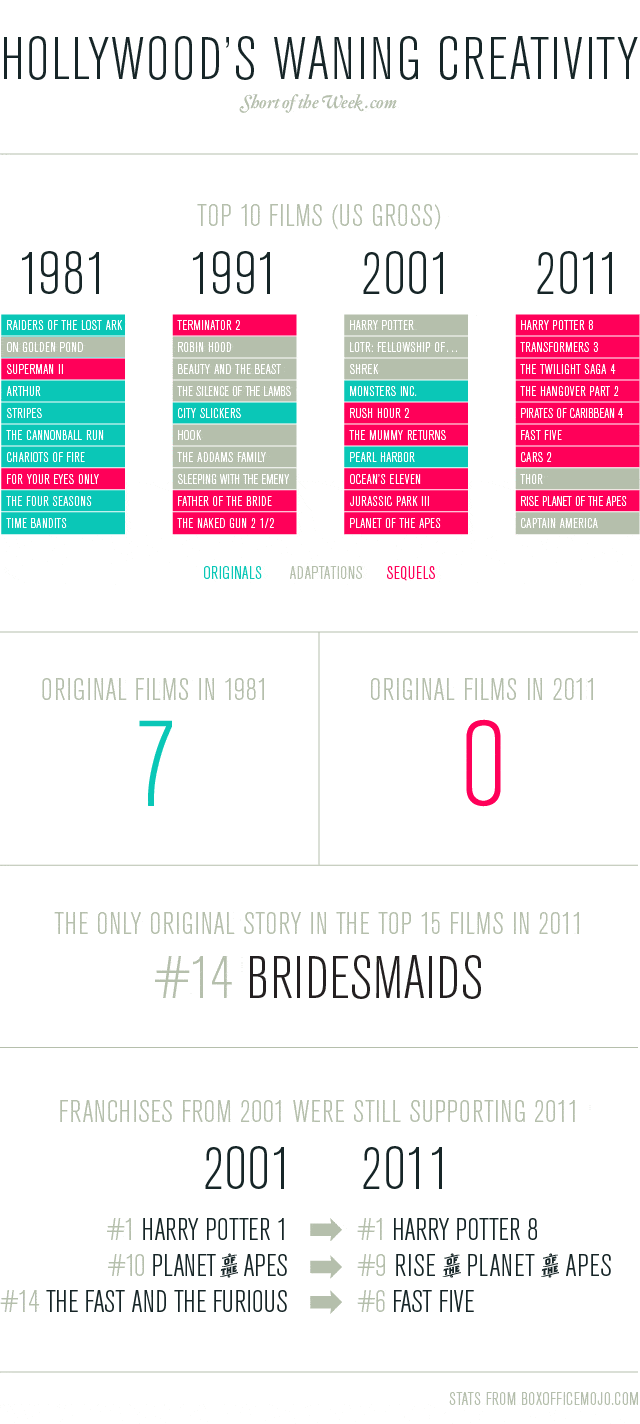
The infographic and its accompanying article were meant as a rallying cry to filmmakers and audiences alike, to stop regurgitating the same-old, same-old and to stop lapping it up like mother's milk. Filmmakers and film lovers took up the banner and cried out "Where are the new voices? The new visions? Give us original content! We demand it!"
Only thing is, you didn't mean it. Oh, your intentions were good. In your heart you really want those original visions. You want to be re-inspired by original movies the way you were when you were a kid. You want that thrill of discovery.
Only, you don't. Not really. There's so much content out there competing for your attention that to invest any sort of time, money, or energy into watching something requires you to know something about it beforehand. Maybe you read the graphic novel. Or played the videogame. Or at the very least you know who's in it. It needs to have a "brand." It needs to be familiar.
Let's take a look at two films that we've posted on our YouTube channel, "Fallout" and "Red Sand."
On the first glance they are fairly similar - both are sci-fi action movies, made with roughly the same production value, same level of acting, same level of writing, and with essentially the same runtime. However one has 4,500 views accrued in just over a year and the other has 133,000 views in just over a month.


That tag on the end of the "Red Sand" trailer provided "Fallout" with its largest single-day viewing spike, though the comparison is still paltry. On May 24, the "Red Sand" trailer brought in over 13,000 views, and passed a mere 500 of those viewers over to "Fallout"(roughly 3.8%).

By comparison, "Fallout"'s own trailer has roughly 3,500 views and has, according to YouTube's stats, prompted just 37 of those viewers to watch the actual "Fallout" film (just over 1%).

Even this graph serves to prove my greater point - that the average viewer will only watch something if it's somehow been granted the appearance of a "known property." In this case, that big spike on April 5, 2011 is just days after "Fallout" won Best Arizona Short at the 2011 Phoenix Film Festival - an assertion of quality by a known entity which says to the viewer "this is worth your time."
So what's the solution for a filmmaker trying to get more eyeballs on his or her films? For a long time that solution seemed to be "name actors." Get a recognizable name and face in your film, and you've got a hit on your hands. Well, yes and no. Casting Mark Meer in "Red Sand" certainly ensured a fair amount of viewership (he is, after all, the voice of Commander Shepard in the Mass Effect games), though one would hardly call him a "household name." Yet in this case he seems to have much more marquee value than "bigger" names like Bill Engvall and Danny Trejo, the stars of our film "Cowboy Dreams" from 2008.
"Cowboy Dreams" was, like "Fallout," an Official Selection of the Phoenix Film Festival. However its total view count is right around 10,000 lifetime views.

Just by math alone, one could make the argument that name actors can roughly double your audience (10,000 for "Cowboy Dreams" compared to around 5,000 for "Fallout"), but a known property like Mass Effect can multiply your audience by a factor of 20 or more.
And before you dismiss this article as simply focusing on YouTube stats, realize that I am using these stats which I have at my fingertips to illuminate a broader point. One need look no further than this summer's box office to see the evidence of my thesis. Compare the opening weekends of the Alien prequel Prometheus ($51 million) and the original story Looper ($20 million). They're both high-concept sci-fi with all-star casts, and yet their box office takes are inversely proportional to their quality.
In conclusion, before you decry "Hollywood's lack of originality" you really should look at yourself - and the rest of the audience - as the ones lacking originality! It's you, the viewer, who doesn't embrace original visions, new voices, unique stories. It's you, the viewer, who is ensuring a continued diet of the same-old, same-old! So if you're truly tired of the regurgitated pablum Hollywood is feeding you - stop consuming it. Watch something new. Find those hidden gems on Netflix, Hulu, YouTube, Vimeo, etc. Go to a film festival. Check out the arthouse instead of the multiplex this weekend. But for the love of cinema, become part of the solution instead of just complaining about the problem!
Monday, November 5, 2012
UAT Wins 3 Awards at Inter-college 48 Hour Film Challenge
 This weekend, two teams of UAT DV students competed in
the 5th Semi-Annual Valley-Wide Inter-college 48 Hour Film Challenge, hosted by
Grand Canyon University. (This is a recurring event that happens twice a year;
GCU hosts in the Fall and we host in the Spring.) 12 teams total competed,
representing GCU, UAT, ASU, and both Scottsdale and Glendale Community
Colleges.
This weekend, two teams of UAT DV students competed in
the 5th Semi-Annual Valley-Wide Inter-college 48 Hour Film Challenge, hosted by
Grand Canyon University. (This is a recurring event that happens twice a year;
GCU hosts in the Fall and we host in the Spring.) 12 teams total competed,
representing GCU, UAT, ASU, and both Scottsdale and Glendale Community
Colleges.
GCU Professor Gregg Elder assembled a panel of judges
from the UAT and GCU faculties, as well as from the local film community. Four
awards were given, Best Acting, Best Technical, Best Directing, and Best
Overall Film. The Best Overall award included not only an individual trophy for
the film, but the custodianship of the newly-minted "Persistence of
Vision" Cup which like the Stanley Cup will be housed on the winning
team's campus until the next challenge.
 One of the UAT films, "Apart From Your World,"
won three out of the four awards and took home the POV Cup for Team UAT. The
film, a musical exploration of geekdom that was filled with visual effects
sequences inspired by Buffy the Vampire Slayer, Superman, Star Wars, and many
more, won Best Acting for UAT student Nathan Benson (who also sang), Best
Technical, and Best Overall Film.
One of the UAT films, "Apart From Your World,"
won three out of the four awards and took home the POV Cup for Team UAT. The
film, a musical exploration of geekdom that was filled with visual effects
sequences inspired by Buffy the Vampire Slayer, Superman, Star Wars, and many
more, won Best Acting for UAT student Nathan Benson (who also sang), Best
Technical, and Best Overall Film.Wednesday, October 31, 2012
The Making of RED SAND
The UAT Digital Video team has put together 4 behind-the-scenes documentaries about the making of our epic Mass Effect prequel fan film, RED SAND! The videos give a great look into the creative process, the nuts and bolts of VFX-heavy filmmaking, and the community of UATDV students. It's 22 minutes of behind the scenes awesomeness. Check it out!
Monday, October 22, 2012
ONE Community: 'Karen & Nelda'
UAT Digital Video is delighted to share the story of "Karen & Nelda" which debuted on Spirit Day at the ONE Community Spotlight on Success Local Heroes Awards. The video was produced by UATDV students and faculty in cooperation with ONE Community.
This special tribute and video tells the story of Nelda Majors and Karen Bailey who have been together for 54 years. They met when they 18 and 19 years old. Nelda knew that she was gay, yet Karen was in a relationship with a soldier for 4 years prior to their meeting. Six months after their friendship began; Karen came back from spring break and told Nelda that she loved her. Both women were raised in Texas and have lived in the Valley for the last several years. The journey of their lives together and how society’s views have evolved over the last 50+ years was documented at the Spotlight on Success Local Heroes Awards which celebrates LGBT history month and twelve LGBT and allied ONE Community business members in October of each year.
Saturday, October 20, 2012
24-Hour Film Challenge: 'Concealed Chronicle'
Here's a fun little film a team of UAT Digital Video students produced for the summer 2012 A3F 24 Hour Film Challenge. That's right, they did this in one day from start to finish! And, it was in the Top 20 Films in the Challenge!
Parameters for the challenge were a required line ("Let's get this over with"), a required prop (a box which had to be opened or closed), and a required theme ("a hidden agenda").
More info about the challenge: http://www.thea3f.net
Parameters for the challenge were a required line ("Let's get this over with"), a required prop (a box which had to be opened or closed), and a required theme ("a hidden agenda").
More info about the challenge: http://www.thea3f.net
Friday, October 12, 2012
'Flight of the Melvin' Selected for 2012 Aliens to Zombies Film Festival!

The Aliens to Zombies screenings will be held on the evenings of Monday, October 29 (9-11 p.m) and Tuesday, October 30 (9-11 p.m.) at the W Hotel in Hollywood.
More info and tickets: http://www.alienstozombies.com/

Wednesday, October 10, 2012
RED SAND Released!
After 9 months of post-production, our latest sci-fi epic RED SAND: a Mass Effect fan film has been completed and released! The film debut on YouTube on Sunday October 7th following a live pre-show with star Mark Meer (the voice behind Commander Shepard in the Mass Effect games), and has scored 75,000 views in just under 4 days. We could not be happier! Check it out below:
And we are thrilled to announce that RED SAND has begun receiving invitations to cons and film festivals! This evening we were invited to screen at the following events in 2013!
RadCon 6A - SF&;F Convention - February 15-17, 2013 - Pasco WA http://www.radcon.org/
Seattle Crypticon - Memorial day weekend - Seattle WA
LoneStarCon3 Film Festival - Aug 29 -Sept 2, 2013 - San Antonio, TX http://lonestarcon3.org/
TCIF3 Film Festival - October 2013 - Richland WA http://www.tcif3.com/
If you want to see RED SAND on the big screen, and you live in any of the above locales, mark your calendars! More info as it develops!
And we are thrilled to announce that RED SAND has begun receiving invitations to cons and film festivals! This evening we were invited to screen at the following events in 2013!
RadCon 6A - SF&;F Convention - February 15-17, 2013 - Pasco WA http://www.radcon.org/
Seattle Crypticon - Memorial day weekend - Seattle WA
LoneStarCon3 Film Festival - Aug 29 -Sept 2, 2013 - San Antonio, TX http://lonestarcon3.org/
TCIF3 Film Festival - October 2013 - Richland WA http://www.tcif3.com/
If you want to see RED SAND on the big screen, and you live in any of the above locales, mark your calendars! More info as it develops!
Subscribe to:
Posts (Atom)